For most of the last two years, the AI inside your business software could answer a question. Summarize this email. Draft that quote. Suggest a reply. Somewhere in the last year the line moved. The same software can now send the quote, book the appointment and reorder the material, and in a growing number of tools it does that without anyone clicking approve. Three separate pieces of research describe that shift. None of them is a survey of small Okanagan shops, and I'll say where each one falls short. Together they still make a point most owners haven't dealt with: the decision about what your software is allowed to do on its own is being made right now, and in a lot of businesses nobody is making it.
The sources and their limits
Three data points, in the order I'd weight them.
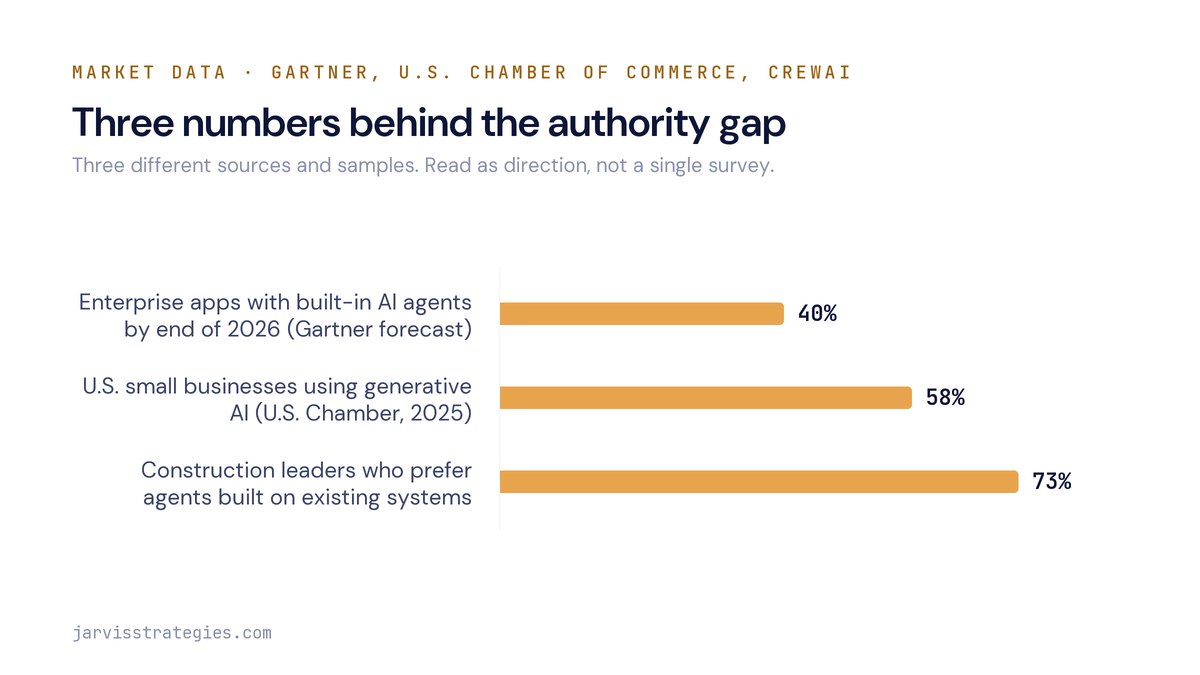
- Gartner, August 2025. Gartner predicted that 40% of enterprise applications will feature task-specific AI agents by the end of 2026, up from less than 5% in 2025. That's a forecast from an analyst firm, not a measurement, and Gartner's clients are mostly large companies and the vendors selling to them. The reason it matters to a small shop is that the applications in question include the scheduling, accounting and CRM platforms small businesses rent by the month.
- U.S. Chamber of Commerce, August 2025. The Chamber's Empowering Small Business report, produced with Teneo Research, found 58% of U.S. small businesses self-identified as using generative AI, up from 40% the year before and 23% the year before that. The public summary doesn't give the sample size or fieldwork dates, so hold the precision loosely. It's a U.S. figure with no industry breakout.
- CrewAI, February 2026. CrewAI, a company that sells software for building and running AI agents, surveyed 500 C-level executives and senior leaders at organizations with more than $100 million in revenue and more than 5,000 employees across seven regions. That is the opposite of a small business. The industry breakouts are the useful part. Construction respondents showed the strongest preference of any industry, 73%, for building AI agents on top of the systems they already run rather than replacing them, with manufacturing at 63%. And 34% named security and governance as the top factor in evaluating an agent platform. Return on investment was named by 2%.
So: a forecast, a self-reported adoption number with thin methodology, and an enterprise survey from a vendor. I'm using them for direction only. Where this post talks about your business, that's my reading, not theirs.
The line moved from "suggests" to "does"
An AI assistant produces something for a person to act on. An AI agent is given a goal and takes the steps itself. I wrote about that distinction in What Is an AI Agent?, and at the time it was mostly a definition. Gartner's forecast is what it looks like when the definition becomes a product roadmap: by the end of this year, a large share of business software will ship with agents built in.
What that means in practice is less dramatic than it sounds and more important. Your scheduling tool gets a feature that confirms appointments and sends reminders on its own. Your accounting software gets one that chases overdue invoices. Your CRM gets one that follows up with leads that have gone quiet. Each of those arrives as a release note and a toggle, and in many tools the toggle starts in the "on" position.
The tools didn't change overnight. The line between "suggests" and "does" moved, inside software you already pay for, and the release notes rarely say "this can now act without you."
You've probably already adopted it
The Chamber's 58% counts owners who say they use generative AI on purpose: someone typing into ChatGPT or Copilot. It doesn't count the AI already inside the tools they rent. Add that in and the real share of small businesses with AI acting in their operations is higher than any survey of deliberate use will show, because a lot of it was never decided by the person running the business. It was decided by a settings menu.
That's the authority gap. Not whether to adopt AI. Most owners already have, in one form or another. The gap is between what the software is now authorized to do and what the owner has consciously agreed to let it do.
In 18 years in construction, I never saw a foreman let a new sub start work without someone saying what they were and weren't allowed to touch. That conversation took five minutes and prevented most of the expensive surprises. Software that acts on your behalf deserves the same five minutes, and it's mostly not getting them.
What goes wrong when nobody signed off
A hypothetical, because the failure is easier to see in a story than a statistic. A plumbing contractor's CRM adds a follow-up agent. Its job is nudging estimates that haven't been accepted. It works well for a month. Then a price list gets updated in one place and not another, and one Monday it emails forty customers a quote built on last year's rates. Nobody approved those emails. Nobody reviewed them. The agent did exactly what it was built to do, which was act without waiting on a person.
Nobody has to be at fault for that to cost a client. That's the point of the CrewAI finding that security and governance beat return on investment as the top evaluation factor among companies already running agents at scale. Those are enterprises with legal departments, and they've concluded that an agent with no boundary is efficient right up until it isn't. A 15-person shop has less margin for the same mistake, not more.
An agent that can send a quote can also send the wrong one. The boundary has to exist before the feature goes live, because afterward it has already been used.
Construction and manufacturing are building on what they have
The industry split in the CrewAI survey is the finding I least expected. Construction respondents were the most likely of any industry, at 73%, to prefer building agents onto their existing systems rather than replacing them. Manufacturing followed at 63%. Financial services, which usually leads these lists, was at 71%.
These are large companies, so don't read it as a description of your competitors down the road. Read it as the direction the industry's biggest players have chosen: layer the new capability onto the tools already in use, don't rip and replace. That's the right instinct for a small shop too, and it's the one I'd recommend. It's also exactly the path that creates the authority gap, because layering onto existing tools means the agent features arrive inside software you already trust, with the permissions that software already has.
Houzz's construction data showed the same pattern from the other side, which I covered in Construction Firms Now Use AI Daily, and Not Just for Estimates: firms using AI every day across sales, estimating and admin, mostly inside tools they already had.
Draw the line in one sitting
The fix is not a six-month project or a policy document nobody reads. It's a short list, and it fits on one page.
- What can run without me? Reminders, internal summaries, drafts that stay drafts.
- What needs a person to look at it first? Anything that touches money, a contract, a customer's inbox or a relationship that took years to build.
- Who is that person, and how will they know when something has gone out?
Then go through each tool you pay for and check what its AI features are set to do. Most vendors publish this in the settings or the release notes. Turn off what you haven't agreed to. Leave on what you have, with the review step in place. That's governance for a small business: accountability, data boundaries and quality control, written down before the tool acts rather than after.
None of this requires knowing how the technology works. It requires knowing your own business well enough to say which decisions you're willing to hand over, which is a question every owner can answer in an afternoon.
What to do with this
If you run a trades, construction or manufacturing business, assume your software can already take actions you haven't explicitly approved, and go find out what they are. Make the short list above. Set the toggles to match it. Tell the people who use the tools where the line is.
Mapping what's already switched on in your stack, and deciding on purpose what stays on, is the first thing covered in the AI Discovery and Readiness Assessment. It's a paid engagement with a defined scope: a discovery call, structured input from the people doing the work, and a written answer for your business, not a slide deck about AI in general.