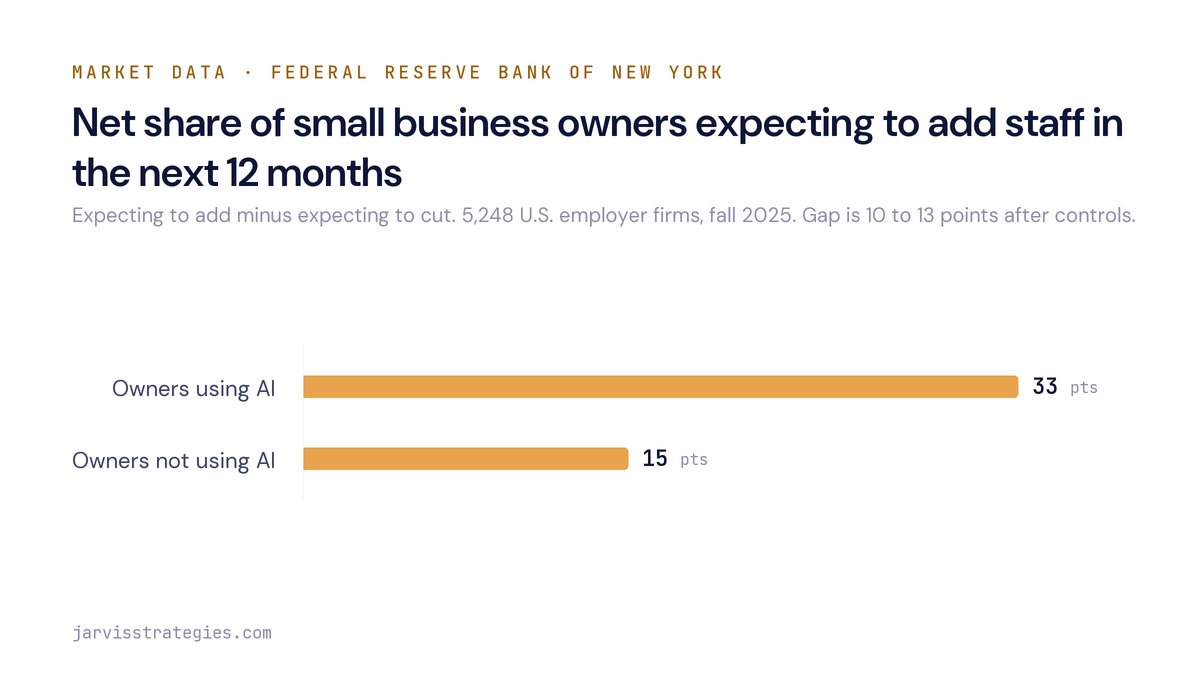
Ask around a trades shop or a plant floor what AI means for jobs and you'll get the same answer most places: fewer people. A survey of more than five thousand small business owners, published by the Federal Reserve Bank of New York this month, points the other way. The owners already using AI are more likely to expect to add staff than the owners who aren't. The same study is careful about what that does and doesn't prove, and it includes a number that should cool off anyone expecting AI to shrink their payroll.
The survey and its limits
The New York Fed published "AI Adoption and Employment Expectations: Evidence from a Survey of Small Business Owners" on its Liberty Street Economics blog on October 8, 2026. The authors are Will Aarons and Asani Sarkar. The data come from the 2025 Small Business Credit Survey, which the Federal Reserve Banks field every year. The AI questions were answered by 5,248 U.S. employer firms, meaning businesses with at least one employee, between September and November 2025, and the results are weighted to match the national population of small employers.
This is government research with no software vendor behind it, which is rarer than it should be in AI surveys. It still has limits worth stating up front.
- The data are a year old. The post is from October 2026. The answers were collected in fall 2025. A lot changes in a year of AI, and the numbers describe owners' plans as of last fall.
- No trade, no province. There's no construction, trades or manufacturing breakout, and nothing for Canada or BC. It's a national U.S. all-industry sample of small employers.
- Expectations, not payroll records. The hiring figures are what owners said they expect to do over the next twelve months. The authors say outright that their findings are associations, not causal effects, and that whether firms achieve what they expect is "a subject for future research."
Who's using AI
Forty-six percent of employer firms said their business or their employees were using AI tools, and another 15% planned to adopt within twelve months. Among the users, 63% said AI was somewhat or very important to how they produce what they sell, and 51% had integrated it partially or fully into operations.
So as of last fall, roughly six in ten small U.S. employers were either using AI or planning to within the year. For comparison, Statistics Canada's 2026 figures put Canadian business adoption at about 19%, with construction near the bottom, which I covered in Construction Sits Near the Bottom of Canada's AI Adoption Numbers. Different survey, different definition of "using AI," different country, so don't line them up as a direct comparison. The gap in direction is still hard to miss.
The hiring gap, before and after the adjustments
The study's main measure is a net figure: the share of owners expecting to add employees over the next twelve months, minus the share expecting to cut. Among owners using AI, that net came out to 33 percentage points in favour of adding. Among owners not using AI, it was 15 points.
That raw gap is about 18 points, which is my subtraction. The authors then did the thing a careful reader would want. They controlled for the characteristics of the firm, the owner and the location, and the gap fell to 13 points. When they also accounted for whether the firm had already been growing its headcount, the gap fell to 10 points. It shrank. It didn't disappear.
The same pattern shows up in revenue. AI users' net expectation of higher revenue was 48 points, against 21 for non-users.
Here's the honest reading. Busy, growing, profitable businesses are more likely to try AI and more likely to plan on hiring. The survey can't tell you which causes which, and the authors don't claim it can. What it can say is that across thousands of owners, the ones using AI leaned further toward adding people, not cutting them, and that lean survived the adjustments.
A plan to hire is not a hire. But five thousand owners planning in the same direction is a direction.
The payroll line didn't move
This is the number I'd put in front of anyone buying AI to cut labour costs.
Seventy-seven percent of respondents said using AI had changed nothing about their firm's current labour costs. And only 31% said AI had increased their sales.
The post says "respondents" for both figures without spelling out whether the base is all respondents or only AI users. Read them as the survey states them. Either way, for most of the people answering, AI had neither cut a wage nor brought in work by the time they were asked.
Eighteen years in construction taught me that every piece of equipment had to answer one question: what did it do to the cost line or the revenue line? Hold AI to that. In this survey, most owners using it couldn't point to a change on either line yet. That's not a verdict on the technology. It's a snapshot of where small businesses were a year ago, and it lines up with what I found in Most Small Businesses Already Use AI. Trust Is What Stops Them Going Further, where the owners seeing a return were split from the ones who weren't.
If you're counting on AI to replace a wage, you're betting on something most of these owners hadn't seen.
Bigger shops were more optimistic
Firms with more than ten employees, younger firms and more profitable firms all had more optimistic employment expectations. The authors add a line that owners of small crews should read twice: small firms may lack the staff, technical expertise and resources to apply AI effectively.
That cuts against the usual pitch. The owner who would gain the most from getting hours back is often the one with nobody to set the tool up and nobody to check it once it's running. A crew of six and a crew of sixty never bought tools the same way, and they won't adopt AI the same way either.
So for a small shop the question isn't whether AI works. It's whether you can run it with the people you have. That's the same constraint that showed up in the construction workforce data I covered in The AI Boom Is Reaching Contractors Through the Hiring Market, where contractors expected technology to cover roles they can't fill rather than replace roles they have.
What "AI adds output" looks like at a small scale
A hypothetical, since the survey doesn't give one. A 20-person HVAC contractor has one office coordinator handling quotes, scheduling, invoicing and follow-ups. She's the bottleneck, and the owner knows it. The usual answer is a second office hire the business can't quite justify yet.
Instead, the owner puts an AI tool on the two tasks that eat her afternoons: drafting quotes from the techs' site notes and writing the follow-up emails on open estimates. She reviews every draft before it goes out. Within a couple of months she's clearing the same work in less time, more estimates get followed up, and a few more jobs close. Now the second hire is a field tech, because the office can handle the extra volume.
That's the shape of what the Fed's numbers describe. AI didn't cut a job. It changed which job got added. And note what made it work: a specific task, a person checking the output, and a number (follow-ups sent, jobs closed) that could be looked at afterward.
What the Fed can't tell you about your trade
Nothing in this survey is about your industry or your province. The findings are associations between what owners use and what they expect. They were collected a year ago. And the one hard number about results, the 77% reporting no labour cost change, is the least flattering one in the post.
What survives is narrow and useful. Across a large, weighted, non-vendor sample, owners using AI were not planning to shed people. They were leaning the other way, and most of them hadn't seen a cost saving yet. If you were worried that adopting AI means telling someone they're done, this is evidence against that fear. If you were hoping AI would let you skip a hire, this is evidence that it mostly hasn't, at least not yet.
I wrote about the bigger version of this question in Is AI Going to Take Your Job? This survey is a smaller, closer look at the people who actually sign the paycheques.
What to do with this
If you run a small crew, treat AI as a way to get more out of the people you have rather than a way to have fewer of them. Pick one task that eats a specific person's time, put a tool on it with that person reviewing the output, and write down the number you expect to move before you start. Then check it in ninety days. That's the whole discipline, and it's the one most of the owners in this survey hadn't done when they were asked.
Mapping which tasks that applies to in your business, and sizing the first move to a crew with no IT department, is what the AI Discovery and Readiness Assessment is for. It's a paid engagement with a defined scope: a discovery call, structured input from the people closest to the work, and a written report that starts from your numbers instead of a national average.