Walk through a small machine shop on a Tuesday afternoon and count the spindles that aren't turning. A new survey of U.S. manufacturing executives says small shops have far more of them than big plants do, and that the shops sitting idle mostly blame the same thing: not enough work coming through the door. The same executives expect AI to help most at quoting and costing, the step before a part is ever cut. Those three findings fit together in a way that matters for a shop in the Okanagan.
The survey and its limits
Xometry, an online marketplace that matches buyers with manufacturing capacity, released its 2027 U.S. Manufacturing Outlook on October 1, 2026. The full report says the survey was commissioned by Xometry and conducted by John Zogby Strategies in August 2026, with 150 executive respondents across the United States at small, medium and large manufacturers. The overall margin of error is plus or minus 8 percentage points. The report also says its breakouts by industry, revenue and company size run from about 30 to 55 respondents each and "should be interpreted directionally rather than as precise estimates." Manufacturing Dive covered the findings on October 7.
Three things to hold onto while reading the numbers.
- The sponsor sells the cure. Xometry's business is filling idle capacity with orders from buyers who couldn't find a supplier. A report that finds a lot of idle capacity in small shops is also a report that describes Xometry's market. That doesn't make the count wrong. It means the framing is theirs.
- The size breakouts are small. The headline comparison is between manufacturers under $50 million in revenue and those over $100 million. Each of those groups is a few dozen respondents. The report itself says to read them as direction, not precision, and I'm doing the same.
- "Small" still means bigger than most shops here. A $50 million manufacturer is a large employer by Okanagan standards. There's no Canadian or BC cut, and nothing in the sample looks like a 12-person job shop in Vernon. The pattern may well hold further down the size scale. The survey can't show that.
The gap in idle machine time
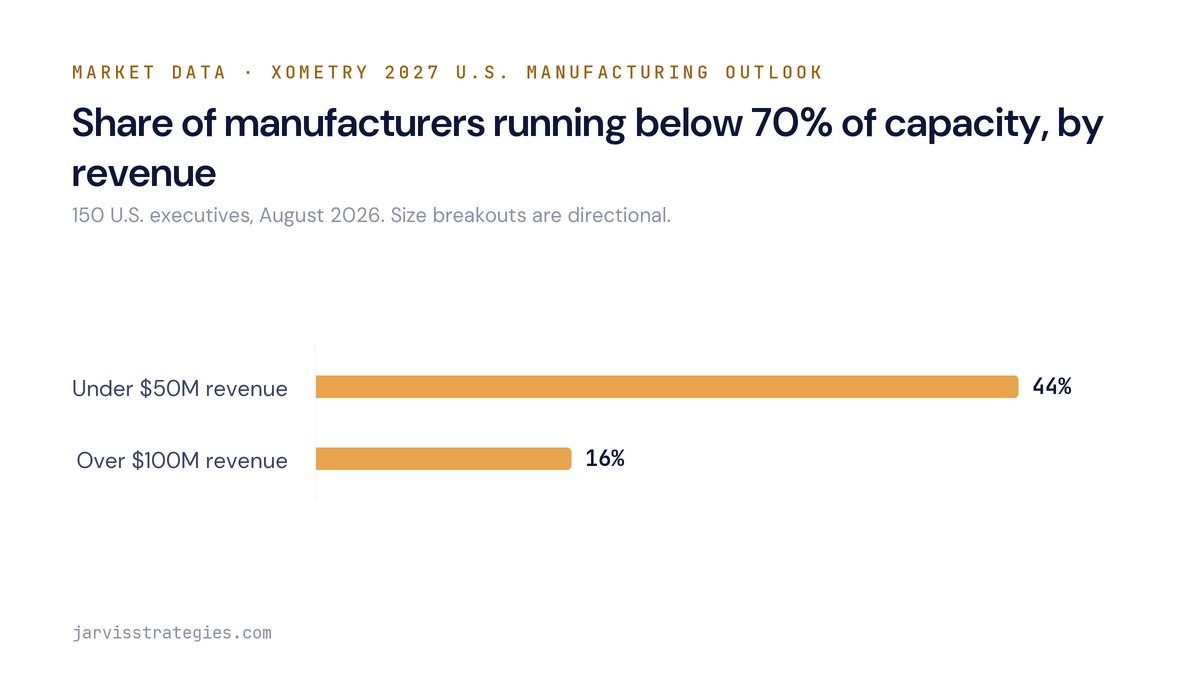
About 44% of manufacturers with less than $50 million in revenue said they were operating below 70% of capacity. Among manufacturers above $100 million, 16% said the same.
The gap holds higher up the scale too. Ninety-three percent of the smaller group said they run below 85% capacity, against 62% of the larger group.
Put plainly, a shop running below 70% has at least three in ten hours of available machine time with nothing on it. That's my arithmetic, not Xometry's, but it's the only way to read the figure. The lease, the equipment payments and the insurance cost the same whether the spindle is turning or not.
Eighteen years in construction taught me the same lesson about crews. A crew with no next job costs almost exactly what a crew with one costs. The difference is whether anything comes back in. Manufacturing runs on that math with more expensive equipment.
The idle shops say the problem is finding work
Among the shops running below 70% capacity, 48% said finding enough work was their biggest obstacle to winning new business. Shops running at full capacity answered differently. Only 9% of them named finding work, and 64% pointed to workforce or capacity constraints.
That's a clean split. The busy shops are short of people and hours. The quiet shops are short of orders.
It also puts the bottleneck for an idle shop somewhere other than the floor. A faster machine or a second shift doesn't help a business that is waiting for the phone to ring. The constraint sits upstream: in how fast a quote goes out, how many inquiries get a reply, how often a past customer hears from you, and whether a buyer who has never heard of you can find you at all.
A shop that is short on orders doesn't have a production problem. It has a pipeline problem that shows up on the production floor.
Where executives expect AI to land
The executives were asked where they expect AI to have the greatest impact on their business in 2027. Manufacturability and costing came first, at 51%. Quality control and inspection followed at 47%. Production execution on the factory floor came in at 32%, and supplier selection and qualification at 25%.
Those are expectations, not measured results. The order is still worth noticing. The top answer is the work of deciding whether a part can be made, how, and what to charge for it. That is quoting. It sits between a buyer's inquiry and a booked order, which is exactly where the idle shops said they were losing.
The report also says 57% of respondents reported significant returns from AI investments, up from 44% the year before, and that almost three-quarters are already applying AI to specific functions or have built it into core operations. Those are executives scoring their own purchases, and the report doesn't define "significant." I'd read the direction and not the decimal.
I covered the measurement side of that problem in Manufacturers Say AI Is Paying Off. Half Can't Show the Numbers. A different survey found that most manufacturers credit AI with results and about half measure the return rigorously. Nothing in the Xometry report changes that picture.
What quoting work looks like in a small shop
Here's a hypothetical that matches a lot of shops I've talked to. A 15-person machine shop gets an inquiry with a drawing attached. The owner, who is also the estimator, opens it between other jobs. Working out the process, the material, the setups and the cycle time takes an hour if nothing interrupts. Something always interrupts. The quote goes out in three days. By then the buyer has two other numbers and has moved on, or the inquiry has gone cold in an inbox.
The AI use the executives are pointing at is narrower than "AI quoting." It's the part where a tool reads the drawing, flags the features that will be expensive to make, suggests a material and process, and drafts the cost build-up so the owner is checking a number instead of building one from scratch. The judgment stays with the person who knows the shop. The three days become a few hours. More inquiries get a reply at all.
That's the manufacturing version of what I've seen in construction estimating, where AI helps with the lookup and the first draft and shouldn't touch the pricing call. I broke that down job by job in Fix the Estimating Bottleneck, and the same split applies on a shop floor.
The hardest hire is the person who runs the tool
One more set of findings cuts against the easy version of this story. Manufacturing Dive reports that AI and automation operators were the hardest roles to fill, named by 34% of executives, ahead of quality engineers at 31%, maintenance technicians at 29%, machinists at 23% and CNC programmers at 20%. The full report confirms the order and adds that in aerospace and defence, half of manufacturers say AI and automation operators are difficult to hire.
Meanwhile, 77% of manufacturers reported larger production backlogs than a year earlier, and only 59% plan to hire in 2027.
So the tool might pay off, and the shop might be busier than ever, but somebody has to run the tool, and that person is the scarcest hire in the survey. In a large plant, that's a job posting. In a small shop, that person has to come from the people already on the payroll, which usually means the owner or the one office person who already does everything.
That's the practical constraint I'd put ahead of any AI purchase for a smaller operation. Not "does the tool work," but "who in this building will set it up, check its output and notice when it's wrong." If the honest answer is nobody, the tool will be renewed out of habit for a year and then cancelled. I made the same point in Manufacturing AI Use Hit 94%. Where the Budget Went Is the Real Story, where people, not technology, came out as the main barrier.
Read the source before you believe the number
Xometry's report is more open about its own limits than most vendor surveys. It names the research firm, the fieldwork month, the sample size and the margin of error, and it warns that the size breakouts are directional. That's worth some credit.
The limits are still real. It's U.S. data with no Canadian or BC cut. The respondents are executives at companies large enough to have executives. The AI figures are expectations and self-reports. And the firm asking the questions sells a way to fill the idle capacity it found.
What survives all of that is a direction. Smaller manufacturers are more likely to have machines waiting on work. The ones waiting say the problem is finding the work. And the people running these companies expect AI to help most at the step where a drawing becomes a price. Three findings pointing the same way is worth paying attention to, even if none of the percentages describe your shop.
What to do with this
If you run a smaller manufacturing operation and the floor is quieter than you'd like, the first question isn't which AI tool to buy. It's where your own pipeline slows down. How long does a quote take from inquiry to sent? How many inquiries never get a reply? When did a past customer last hear from you without a job in progress? Those numbers are yours, no national survey has them, and they're usually easier to find than you'd expect.
Finding where time and margin leak out of the quote-to-order chain, and sizing a first AI step to the people you actually have, is the work of the AI Discovery and Readiness Assessment. It's a paid engagement with a defined scope: a discovery call, structured input from the people doing the work, and a written report that puts your number on paper.